The Reality of Facing Felony Charges Without a Strategic Defense Plan
When you’re facing felony charges, the default assumption is often jail time. Your mind jumps to worst-case scenarios: years behind bars, your career evaporating, your family’s stability shattered. But this assumption exists partly because many defendants never learn that alternatives to incarceration actually exist and are far more accessible than they think.
The criminal justice system in California has evolved significantly. Alternative sentencing options are written into statute, used regularly in courtrooms across our service areas (San Diego, San Bernardino, Orange, Riverside, and Imperial Counties), and represent a legitimate path forward for eligible defendants. The catch is that these alternatives won’t find you. Your defense strategy must actively pursue them.
Without a deliberate plan targeting alternative sentences, you become another case number processed through an overloaded system. Public defenders, despite their dedication, handle 300+ cases annually. Private defense counsel who understand the nuances of California sentencing law can dedicate focused attention to identifying which alternatives apply to your specific charges and circumstances.
Actionable insight: Before accepting any plea offer, demand that your attorney specifically explain what alternative sentencing options were negotiated or explored. If they can’t articulate them clearly, that’s a red flag.
Why Traditional Public Defenders Miss Alternative Sentencing Opportunities
Public defenders are hardworking professionals operating under genuine constraints. Their offices are chronically underfunded, their caseloads are astronomical, and they’re often meeting clients for the first time weeks before trial. These realities create a structural barrier to the kind of individualized advocacy that alternative sentencing requires.
Alternative sentencing requires investigation beyond the criminal facts. We need to understand your employment history, family obligations, community ties, mental health background, substance abuse history, and rehabilitative potential. We need to build a narrative that demonstrates why you’re a candidate for probation, diversion, or treatment-focused sentencing rather than incarceration. This takes time that public defenders simply don’t have.
Additionally, standard public defender offices process cases toward guilty pleas and standard sentencing outcomes. They’re efficient at managing volume, which sometimes means lesser-known alternatives get overlooked. Felony diversion programs, mental health courts, drug courts, and veteran treatment courts exist specifically to serve populations that public defenders handle daily, yet many defendants never learn these programs could eliminate their charges entirely.
We approach each case differently. Our practice structure allows us to spend weeks or months investigating sentencing alternatives tailored to your situation, building relationships with prosecutors who understand these options, and positioning your case for the most favorable outcome available.
Understanding Alternative Sentencing: Your Path Away From Incarceration
Alternative sentencing encompasses any outcome that keeps you out of state prison or county jail. The spectrum is wide and includes several distinct categories, each with different eligibility requirements and benefits.
At the foundational level, alternatives range from formal probation (supervised or unsupervised) to incarceration in residential treatment facilities, day reporting centers, or work-release programs. Some alternatives allow you to serve time on weekends while maintaining employment. Others involve electronic monitoring that lets you stay home while the state monitors compliance remotely.
The critical distinction is between punishment-focused alternatives and treatment-focused alternatives. Punishment alternatives assume you made a deliberate choice and need consequences and supervision. Treatment alternatives assume underlying issues (addiction, mental illness, trauma) contributed to your offense and addressing those issues prevents recidivism more effectively than incarceration.
California recognizes both models. Your defense strategy should identify which model applies to your charges and demonstrate to the prosecutor and judge why that model serves justice better than prison time. We’ve successfully argued that a defendant with no prior record and a documented substance abuse issue is better served through drug court than a state prison sentence. We’ve shown that a defendant with untreated bipolar disorder should enter mental health diversion rather than face years of incarceration that would destabilize them further.
Understanding which alternative applies to you begins with understanding your charges, your history, and the statutory framework that governs sentencing in your county.
Probation, Restitution, and Community Service as Viable Alternatives
Probation is the most common alternative to incarceration and often misunderstood. Probation is not a free pass. It’s a sentence where you remain in the community under court supervision, with conditions you must meet. Violate those conditions and you can be incarcerated for the remainder of your probation term.
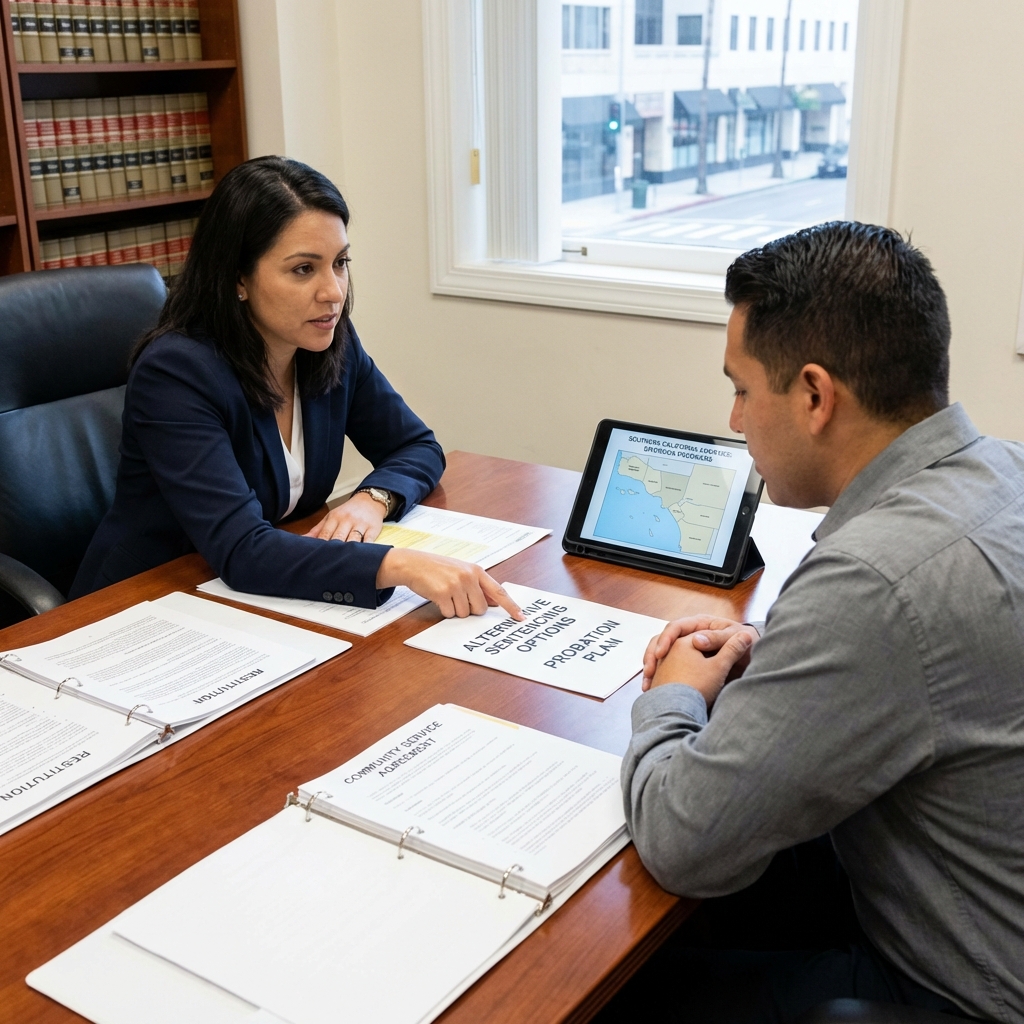
But probation allows you to maintain employment, support your family, and avoid the collateral damage of incarceration. If probation includes restitution (paying your victim for losses), you satisfy that obligation while working rather than sitting in a cell unable to earn. Community service sentences combine the same benefit: you remain free, contribute to your community, and serve your sentence through productive work rather than confinement.
We negotiate probation terms carefully. Standard probation conditions might include monthly check-ins with a probation officer, drug testing, no contact with alleged victims, and geographic restrictions. We push for the most lenient conditions possible. Sometimes that means arguing for unsupervised probation, informal check-ins, or relaxed travel restrictions that allow you to work or attend school across county lines.
Restitution amounts matter too. Prosecutors sometimes request inflated victim losses. We investigate the actual damages and challenge inflated figures. If you can’t pay restitution in full during probation, we negotiate payment plans that are realistic given your employment and family obligations.
Next action: If probation is being offered in your case, request a detailed written breakdown of all proposed conditions before accepting any plea. Conditions sound reasonable in conversation but can become burdensome when you’re actually complying daily.
Felony Diversion Programs We Leverage Across Southern California Counties
Diversion is different from probation. Diversion typically means the case is paused or dismissed entirely if you complete a treatment or supervision program. You avoid conviction. Your record stays clean. The incentive is enormous because most diversion programs end with a dismissal, not a conviction that follows you forever.
California’s Proposition 36 programs (drug diversion), mental health diversion statutes, and veteran treatment courts across our service areas offer paths to dismissal. San Diego County has strong mental health diversion options. Orange County operates several drug court programs. San Bernardino and Riverside Counties have veterans’ diversion available. Imperial County has substance abuse diversion pathways.
Each county’s programs have different eligibility criteria, different costs, different timelines. We maintain current relationships with diversion program coordinators, prosecutors, and judges in each county we serve. This lets us identify which programs align with your case and advocate effectively for your placement.
A client facing felony drug charges in San Diego might qualify for Prop 36 diversion. Complete a treatment program, stay drug-free, and the charges disappear. That’s dramatically different from a felony conviction that blocks employment in healthcare, education, and many other fields. We’ve guided clients through these programs successfully, and the difference in their post-program lives is measurable and real.
Eligibility isn’t automatic. Prosecutors have discretion to oppose diversion in some cases. We build the case for why you belong in diversion by gathering documentation of your treatment history, employment stability, family support, and commitment to change. We present this to prosecutors in writing before case disposition, making the argument for diversion before you’re in front of a judge.
How Our Defense Strategy Positions You for Alternative Sentencing
Our entire approach from first consultation onward prioritizes alternative sentencing. We don’t start with “what’s the best plea deal.” We start with “what’s the path that keeps this client out of custody with the cleanest record outcome possible.”
This requires detailed investigation immediately. We interview you about your background, work history, family obligations, education, military service if applicable, substance abuse history, mental health history, prior criminal record, and community involvement. We obtain records: employment letters, educational transcripts, letters of support from family and community members, medical and mental health records, treatment records. This documentation becomes the foundation of our sentencing brief.
We simultaneously investigate the facts of your case aggressively. Prosecution evidence might have weaknesses. Potential defenses might exist. Our investigation might reveal that the alleged victim’s losses were lower than reported, or that your role was minor compared to others involved. These findings strengthen our negotiating position and can lead to charge reductions that make you eligible for better sentencing alternatives.
We maintain an ongoing dialogue with prosecutors about sentencing. Rather than waiting until trial or the last minute before sentencing, we present our mitigation case early. We say: “Here’s why this client is appropriate for diversion” or “Here’s why probation with no custodial component serves justice better than prison.” Prosecutors who understand your background and potential for rehabilitation are more likely to recommend (or at least not oppose) alternatives.
Finally, we position your case for a favorable judicial outcome. Some judges have particular sentencing philosophies. Some prefer treatment-focused sentences for addiction cases. Others favor probation with restitution for first-time offenders. We research judges’ sentencing patterns and adjust our advocacy accordingly. We know which judges in which counties are receptive to our alternative sentencing arguments.
Record Expungement After Alternative Sentencing: Protecting Your Future
Alternative sentencing helps you avoid incarceration. Record expungement protects your future after sentencing is complete.
If you complete probation successfully, California law allows you to petition to expunge your conviction under Penal Code Section 1203.4. Expungement dismisses the case and allows you to legally state you were never arrested or charged (with limited exceptions for employment in law enforcement, childcare, and other sensitive fields). The difference between a felony on your record and an expunged record is staggering. Employment prospects improve. Professional licensing becomes possible. Housing applications succeed. Your narrative shifts from “convicted felon” to “person with a history who has moved forward.”
Diversion programs often end with automatic dismissal, which is even better. But if your alternative sentence is probation, expungement becomes essential protection for your post-sentence life.
We file expungement petitions for our clients as part of our continuing relationship. We ensure that you’re eligible, that your probation is complete, that you’ve paid restitution, and that you’ve satisfied all conditions. Then we file and appear for the dismissal hearing. Judges almost always grant these petitions, but we make sure the process is handled correctly and that you understand the significant relief expungement provides.
Many defendants complete probation, never hire counsel to handle expungement, and live with a felony conviction on their record permanently. That’s a tragedy that we prevent by staying engaged with you through sentencing completion.
Case Examples: Real Clients Who Avoided Prison Through Our Representation
A client was charged with felony possession for sale of methamphetamine in San Bernardino County. The prosecutor’s initial offer was two years in state prison. The charge carried a statutory range of up to three years. Our client had no prior record, had been working steadily, and had family support.
We gathered employment letters, family statements, and substance abuse treatment records showing prior treatment engagement. We presented this to the prosecutor and advocated for Prop 36 diversion. The prosecutor agreed. Our client entered a treatment program, remained compliant, and the charge was dismissed after two years. No felony conviction. The record was clean.
Another client faced felony DUI causing injury in Orange County. The statutory range was 16 months to three years in state prison. Our investigation revealed that the injury was minor, the accident was partially caused by the alleged victim’s conduct, and our client had strong employment and family ties.
We negotiated a probation-based sentence with restitution. Our client served no jail time, maintained employment, paid restitution, and after five years, petitioned to expunge the conviction. Today, that person works in a field where a felony conviction would have been career-ending.
In San Diego County, a client charged with felony domestic violence had mental health issues that contributed to the offense. We argued for mental health diversion. The prosecutor consented. Our client engaged in mental health treatment, completed the program, and the case was dismissed. No conviction. No record.
These outcomes aren’t unusual. They’re the standard when we represent clients strategically from the beginning, building the case for alternatives rather than accepting the system’s default outcome.
The Cost of Choosing the Wrong Criminal Defense Attorney
The wrong attorney doesn’t cost less upfront. It costs everything in the long run.
An attorney who doesn’t investigate sentencing alternatives, who treats your case as a high-volume plea negotiation, who doesn’t build a mitigation narrative, positions you for incarceration and a permanent felony record. The financial impact is staggering. A felony conviction costs money: lost employment income, reduced lifetime earning potential, licensing restrictions, housing discrimination, and higher insurance costs. We’ve seen clients lose $500,000 or more in lifetime income because of a felony conviction that could have been avoided through better legal strategy.
Beyond money, there’s the human impact. Prison time destroys relationships, destabilizes families, and creates trauma that compounds the underlying issues that may have contributed to your arrest. A parent incarcerated loses years with their children. A young person incarcerated loses their most formative years outside custody. These losses can’t be calculated financially, but they’re real.
Choosing an attorney based on cost alone in a felony case is a financial mistake disguised as savings. We offer competitive flat-fee pricing and flexible payment plans specifically because we understand that criminal defense is a significant investment. But that investment should go to counsel who will fight for alternatives, not toward someone who will process your plea quickly.
Our commitment is different. We dedicate resources to your case because we understand that the consequences of getting sentencing wrong extend decades into your future.
Your Next Steps: Securing Our 24/7 Free Consultation
If you’re facing felony charges anywhere in Southern California, your immediate next step is a free consultation with our office. We’re available 24/7 to discuss your situation, explain what alternative sentencing might look like in your case, and outline our strategic approach.
During that consultation, we’ll ask detailed questions about your background, your charges, your circumstances. We’ll explain California’s sentencing law, the alternatives available in your county, and how we pursue them. We’ll answer your questions directly and honestly, without pressure or sales tactics.
We serve San Diego, San Bernardino, Orange, Riverside, and Imperial Counties. If you’re in our service area and facing felony charges, we can help. Contact us today to schedule your free consultation and learn how we position felony defendants for alternative sentencing outcomes that protect your freedom, your livelihood, and your future.
Your case deserves strategy. Your defense requires someone who understands not just how to negotiate with prosecutors, but why alternative sentencing matters and how to make the case that you’re appropriate for it. We do this work daily, and we’re ready to do it for you.
What alternative sentencing options can we pursue to keep you out of jail?
We work to secure probation, restitution, community service, or enrollment in felony diversion programs depending on your case specifics and county jurisdiction. Our strategy focuses on presenting your circumstances to the court in a way that demonstrates your suitability for alternatives to incarceration, rather than accepting the prosecution’s initial recommendation.
Why should you choose our firm over a public defender for alternative sentencing opportunities?
Public defenders typically carry 400+ cases annually, which limits their ability to thoroughly investigate diversion programs and alternative sentencing options available in your specific county. We dedicate focused attention to each case, maintaining relationships with prosecutors and judges across San Diego, Orange, Riverside, San Bernardino, and Imperial counties to identify lesser-known pathways that reduce or eliminate jail time.
Can we help expunge your record after completing alternative sentencing?
Yes, we handle record expungement as a critical next step once you’ve successfully completed your alternative sentence. Clearing your criminal record protects your employment prospects and housing options, and we guide you through the entire expungement process so alternative sentencing becomes a genuine second chance rather than a permanent mark on your record.