

Table of Contents
- Why Your Misdemeanor Plea Decision Matters More Than You Think
- Understanding What a Misdemeanor Plea Really Means
- How a Misdemeanor Conviction Affects Your Employment and Housing
- The Hidden Costs: License Suspensions, Fines, and Probation
- Criminal Record Consequences That Last Years After Your Case
- When You Should Challenge the Plea Offer Instead
- How We Evaluate Your Options Before Any Plea Agreement
- Protecting Your Rights Through Strategic Defense in Escondido
- Expungement as Your Path to a Fresh Start
- Why Our Approach Differs from Public Defender Representation
- Moving Forward: Your Next Steps to Secure Representation
- Frequently Asked Questions (FAQ)
Why Your Misdemeanor Plea Decision Matters More Than You Think
A misdemeanor plea agreement may seem like a quick resolution to your case. The prosecutor offers what sounds like a reasonable deal. Your public defender or a retained attorney suggests taking it to avoid trial risk. Yet this single decision shapes your employment prospects, housing options, and personal freedom for years to come.
Many defendants in Escondido discover too late that accepting a plea carries consequences far beyond the courtroom sentence. A misdemeanor conviction doesn’t simply disappear after probation ends. Employers, landlords, licensing boards, and government agencies see that conviction indefinitely unless you pursue expungement. The immediate pressure to resolve your case can obscure the long-term impact on your livelihood.
We’ve represented hundreds of defendants facing this crossroads. The clients who made the most informed decisions were those who understood exactly what accepting a plea meant before signing anything. That clarity allows you to weigh the real costs against the benefits of resolving quickly versus fighting the charges.
Your action item: Before your next court date, request a detailed written explanation of all consequences attached to the proposed plea. This document becomes your baseline for evaluating whether the deal truly serves your interests.
Understanding What a Misdemeanor Plea Really Means
When you enter a misdemeanor plea, you are admitting to committing the crime as charged or to a lesser included offense. This admission becomes a formal conviction record. You waive your right to a jury trial, your right to confront witnesses, and your right to appeal most aspects of the conviction later.
Crucially, accepting a plea does not guarantee leniency. The judge still has discretion in sentencing. While prosecutors may recommend a specific outcome as part of the plea agreement, the judge can impose a harsher sentence within statutory limits. You lose leverage at sentencing once you’ve conceded guilt.
California law treats misdemeanor pleas seriously. Unlike infractions, which carry no jail time, misdemeanors can result in county jail sentences up to one year and substantial fines. Even if the prosecutor recommends “time served” or probation, that recommendation is not binding on the court.
The plea agreement itself becomes a binding contract between you and the prosecution. If you violate its terms, the prosecutor can withdraw from the agreement and pursue the original charges with added charges if additional violations occurred.
What to do next: Ask your attorney to explain the specific penal code section you’re pleading to, the maximum penalty under law, and what the judge has authority to impose even if the DA recommends leniency.
How a Misdemeanor Conviction Affects Your Employment and Housing
Employment impact is immediate and often severe. Many employers run background checks before hiring. A misdemeanor conviction appears on those checks, and California law allows employers broad discretion to reject candidates with criminal histories. Some industries, such as healthcare, education, and child care, have strict policies against hiring anyone with certain convictions.
Even if you’re already employed, a new misdemeanor conviction can trigger grounds for termination. Your employer’s hiring policies may permit background checks during employment. Professional licenses in fields like real estate, nursing, and security are regularly suspended or revoked following misdemeanor convictions.
Housing discrimination based on criminal history is equally substantial. Landlords routinely deny rental applications to applicants with misdemeanor convictions. In the San Diego County rental market, where competition for units is fierce, a conviction gives landlords a reason to choose another tenant. Public housing programs have explicit restrictions on applicants with certain criminal histories.
If you’re a homeowner, a misdemeanor conviction doesn’t directly affect your title, but it can complicate refinancing and impact your credit if fines or restitution remain unpaid.
Immediate step: Before accepting any plea, ask your attorney which specific convictions would trigger employment or housing restrictions in your field or situation.

The Hidden Costs: License Suspensions, Fines, and Probation
License suspensions often come as a shock to defendants who focus only on jail time and probation length. A DUI misdemeanor carries a mandatory driver’s license suspension. Drug possession can result in suspension of professional licenses. Even seemingly minor convictions can trigger administrative suspensions through the California Department of Motor Vehicles or relevant licensing boards.
Financial penalties extend beyond the base fine. Most misdemeanor convictions include:
- Restitution to victims
- Court fees and processing charges
- DNA collection fees
- Criminal justice administration fees
- Probation supervision fees (monthly during the probation term)
These costs accumulate quickly. A defendant on a three-year probation period paying $50 monthly in supervision fees pays $1,800 just for probation oversight. Add court fines, restitution, and other assessments, and the total financial burden often exceeds $3,000 to $5,000.
Probation terms themselves carry invisible costs. You must maintain employment, avoid further contact with law enforcement, submit to drug testing if required, and attend counseling or treatment programs. Missing a single probation appointment or failing a drug test can result in probation violation charges and potential jail time.
Your next move: Request an itemized estimate of all financial obligations, including probation fees, before you agree to any plea.
Criminal Record Consequences That Last Years After Your Case
Your misdemeanor conviction remains on your criminal history indefinitely without expungement. This permanent record affects you in multiple ways:
Immigration consequences arise even for misdemeanor convictions. Non-citizens risk deportation or denial of citizenship based on certain misdemeanor convictions, including crimes involving moral turpitude. If you’re not a U.S. citizen, a misdemeanor plea can trigger immigration consequences that far exceed the criminal sentence.
Background check visibility is extensive. Online background check services, tenant screening companies, and employment verification agencies can access your conviction record. Many of these services charge you to view what’s being reported, yet you have limited ability to correct inaccurate information quickly.
Government benefits eligibility may be affected. CalFresh (food assistance), housing choice vouchers, and other public benefits have restrictions for applicants with certain convictions. Student loan eligibility is unaffected by most misdemeanors, but criminal history can disqualify you from certain financial aid programs.
Financial lending becomes more difficult. Lenders review criminal history as part of risk assessment. While a misdemeanor alone doesn’t prevent loan approval, it signals risk and may result in higher interest rates or declined applications.
Action item: Speak with an attorney about the specific long-term collateral consequences of your particular charge in your situation, not just the criminal sentence itself.
When You Should Challenge the Plea Offer Instead
A plea offer can be rejected if the prosecution’s case has weaknesses you can exploit at trial. Weak physical evidence, credibility problems with witnesses, and procedural violations by law enforcement all provide grounds to fight rather than accept.
Consider rejecting a plea if the offered resolution involves a conviction for a crime requiring sex offender registration, professional license revocation, or mandatory prison time. The collateral damage often outweighs the certainty of a quick resolution. Some charges demand trial evaluation even if conviction risk is moderate.
Evaluate the strength of the prosecution’s evidence honestly with your attorney. Police reports containing inconsistencies, evidence lacking proper chain of custody, and witness statements contradicted by video or physical evidence are red flags suggesting trial is viable. Conversely, clear video footage, your own statements to police, or physical evidence directly linking you to the crime makes trial extremely risky.
Payment ability matters too. If the plea includes fines or restitution you cannot afford, probation fees that will bankrupt you, or license suspensions that destroy your livelihood, trial may be preferable despite higher conviction risk. A trial acquittal eliminates all these consequences; a conviction on different charges might result in lesser collateral damage.
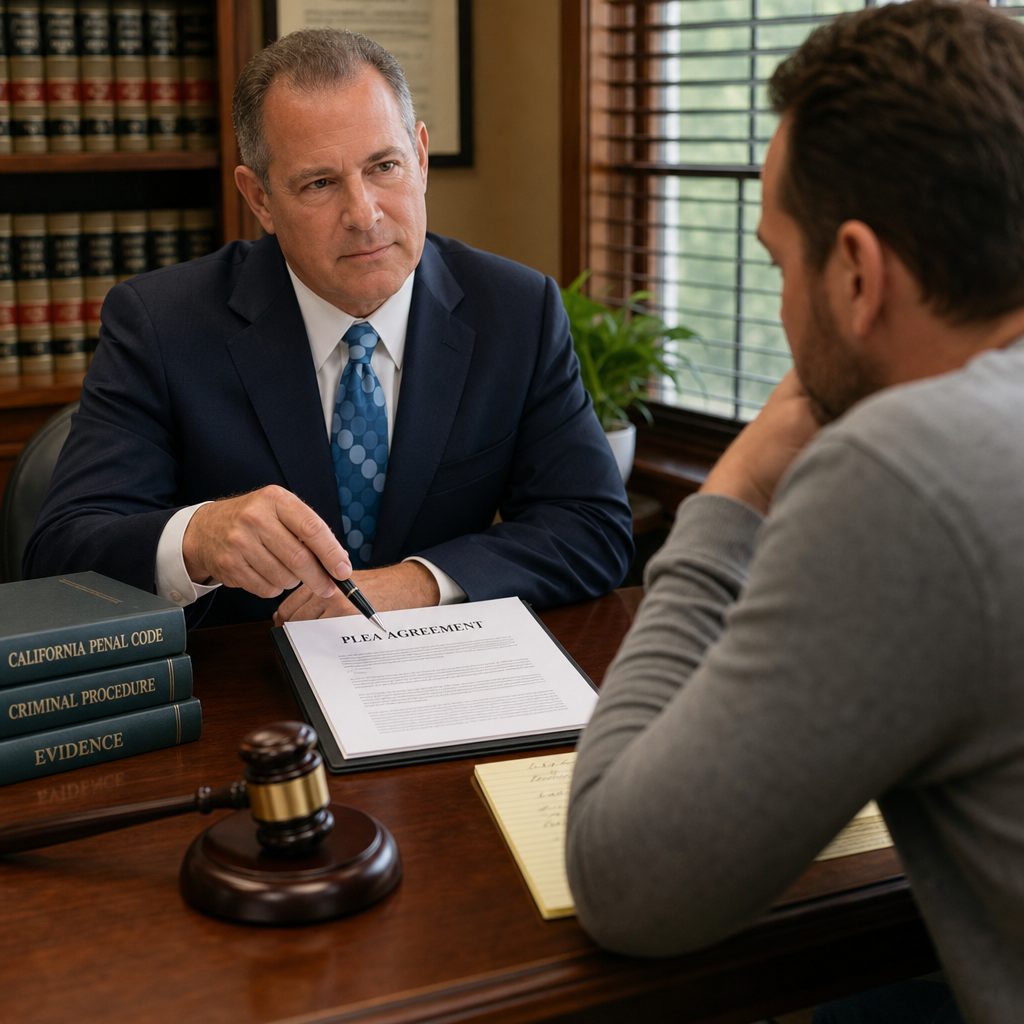
Decision point: Schedule a comprehensive case evaluation with your attorney specifically examining the prosecution’s evidence and your trial defenses before accepting any offer.
How We Evaluate Your Options Before Any Plea Agreement
Our approach differs fundamentally from rushed case resolution. We conduct a thorough investigation of your case, reviewing police reports, witness statements, evidence logs, and any video or audio recordings. We examine whether law enforcement followed proper procedures during arrest and investigation. Procedural violations often provide grounds to suppress evidence or exclude statements, weakening the prosecution’s case significantly.
We calculate the true cost of accepting any plea agreement. This includes not just jail time and fines, but employment impact, housing barriers, professional license consequences, and long-term collateral damage. We compare these costs against the realistic risks of trial, including conviction probability, sentence exposure, and appeal limitations.
We also examine your specific circumstances. A first-time offender with steady employment and family ties has different trial-decision calculus than someone with prior convictions. Your age, employment status, housing stability, and immigration status all affect the analysis.
Only after this comprehensive evaluation do we recommend acceptance or rejection of a plea. We never recommend accepting a plea simply because it’s offered. We recommend it only when our analysis shows that the collateral consequences of conviction are outweighed by the risks of trial.
What you should expect: Your attorney should provide a written summary of the evidence, trial risks, plea consequences, and recommendation before any plea agreement is finalized.
Protecting Your Rights Through Strategic Defense in Escondido
Escondido courts handle hundreds of misdemeanor cases annually. The court system is efficient, and judges expect attorneys to understand local procedures and judges’ sentencing practices. Our representation in Escondido leverages this familiarity to your advantage.
We identify local procedural advantages specific to how Escondido courts handle discovery, evidence admissibility, and witness examination. We understand the local prosecutors’ office priorities and negotiation patterns. This knowledge allows us to evaluate plea offers against what similar cases typically resolve for in your courthouse.
Our trial preparation focuses on Escondido jurors’ perspectives. Jury composition, community values, and local attitudes toward specific crimes inform how we present defenses and frame evidence. Mock jury feedback during preparation helps us refine strategy before actual trial.
We also ensure proper constitutional protection throughout your case. From arrest through sentencing, we verify that law enforcement and prosecutors followed proper procedures. Violations of your rights provide grounds to suppress evidence or dismiss charges entirely.
Essential action: Select representation specifically familiar with Escondido courts and procedures rather than an attorney handling cases across multiple counties with less local focus.
Expungement as Your Path to a Fresh Start
Even after conviction, California law allows record expungement under Penal Code sections 1203.4 and 1203.4a. Expungement is not erasure. Your record still exists within the court system. But expungement allows you to legally answer “no” when asked whether you have a criminal conviction in most employment, housing, and professional licensing contexts.
Eligibility depends on your sentence. If you served probation, you can petition for expungement after completing probation successfully. If you served jail time, you can petition immediately or wait until probation is completed. Some felonies reduced to misdemeanors under Proposition 47 become eligible for expungement immediately.
The expungement process requires filing a petition with the court, serving the prosecutor, and obtaining a hearing date. In many cases, the prosecutor doesn’t oppose expungement, particularly if you’ve completed probation successfully and avoided further criminal conduct.
Success in expungement removes the conviction from your background check results, from employer access, and from housing screening databases. A future employer conducting a background check will not see that conviction. A landlord checking your history will see a clean record in most databases.
Our Escondido expungement services handle the entire process from petition drafting through court hearing. We ensure the petition is complete, timely filed, and presented persuasively to the judge.
Next step: Even if expungement isn’t immediately available, discuss the timeline and process with your attorney during your initial case evaluation.
Why Our Approach Differs from Public Defender Representation
Public defenders handle enormous caseloads, often managing 200 to 400 active cases simultaneously. This volume necessarily limits investigation depth, trial preparation, and individualized attention. A public defender may have 15 minutes to discuss your case before recommending a plea offer they believe serves your interests.
Our practice focuses on thorough case evaluation and client communication. We take a manageable caseload specifically to provide the investigation depth and trial preparation that serious defense demands. We don’t recommend pleas based on case volume or courthouse efficiency; we recommend them based on honest assessment of your circumstances.
We also invest in investigative resources that public defender offices cannot sustain. We hire investigators to interview witnesses, locate evidence, and identify defense angles. We consult with experts in forensics, toxicology, or other technical fields when evidence demands specialist review.
Our fee structure differs too. We offer transparent flat-fee pricing and flexible payment plans specifically designed for defendants who can’t afford contingency-based representation. This approach ensures your attorney has incentive to develop your case thoroughly, not to resolve quickly and move to the next client.
Most importantly, our professional experience spans over 30 years of courtroom practice. We bring seasoned judgment to evaluating offers, negotiating with prosecutors, and protecting your rights through every phase of your case.
Moving Forward: Your Next Steps to Secure Representation
Begin by scheduling a free 24/7 consultation with our office. This conversation costs nothing and creates no obligation. We’ll review your charges, discuss your circumstances, and explain how we evaluate your case.
Bring documentation to your consultation: arrest reports, citations, any prosecutor correspondence, and details about your employment and housing situation. This information helps us understand your case and explain potential consequences accurately.
Be honest about the facts, your background, and your concerns. Your attorney cannot advise you effectively without complete information. Anything you disclose in consultation is protected by attorney-client privilege and remains confidential.
Ask specific questions about our experience with your charge type, our trial record, and our negotiation success in your circumstances. Understand our fee structure and payment options before committing.
Our Escondido criminal defense lawyer service is built around one principle: your rights and long-term interests come first. We protect your freedom, your livelihood, and your record with the seriousness this deserves. Contact the Law Offices of Victor Orsatti today to begin your defense.
Frequently Asked Questions (FAQ)
What happens to my employment and housing opportunities after I accept a misdemeanor plea in Escondido?
When you plead guilty to a misdemeanor, that conviction becomes part of your permanent criminal record, which employers and landlords can access during background checks. Many employers won’t hire candidates with recent convictions, and landlords often deny housing applications based on criminal history. We’ve seen clients lose job opportunities and face rental discrimination years after their plea, which is why we carefully evaluate whether accepting a plea offer truly serves your long-term interests before you commit.
How do we approach your case differently than a public defender would?
We handle significantly fewer cases than public defenders, which means we dedicate substantial time to analyzing every aspect of your situation and exploring alternatives to plea agreements. Unlike overworked public defenders juggling hundreds of cases, we personally investigate whether the prosecution’s evidence is solid, identify potential weaknesses in their case, and negotiate from a position of strength rather than convenience. We also explain each consequence of a plea directly to you so you make an informed decision rather than being pressured into an agreement.
Can I remove a misdemeanor conviction from my record after accepting a plea?
Yes, we can petition the court to expunge your misdemeanor conviction under California law, which essentially seals and dismisses your case. Expungement doesn’t erase the record entirely, but it allows you to legally answer “no” to most questions about arrests or convictions on job applications and rental forms. We guide many of our clients through the expungement process once they’re eligible, giving them the fresh start they deserve.
Leave a Reply
You must be logged in to post a comment.