
Drug Possession Motion to Suppress: How We Challenge Unlawful Searches
12
Sep
Drug Possession Motion to Suppress: How We Challenge Unlawful Searches
Table of Contents
- When Police Searches Violate Your Constitutional Rights
- Why Your Drug Possession Case May Rest on Suppression
- The Fourth Amendment Protections We Leverage for Your Defense
- Common Violations That Make Evidence Inadmissible in Drug Cases
- How Our Motion to Suppress Strategy Works
- Evidence Our Team Successfully Challenges in Court
- Why Courts Grant Suppression Motions in Drug Possession Cases
- The Critical Difference Between Public Defenders and Dedicated Defense
- Your Next Steps: Securing a Motion to Suppress Hearing
- How We've Helped Southern California Defendants Get Charges Dismissed
- Frequently Asked Questions (FAQ)
When Police Searches Violate Your Constitutional Rights
A motion to suppress is often the most powerful tool available in a drug possession defense. When law enforcement conducts an unlawful search, any evidence recovered during that search becomes legally unusable in court. We have spent over three decades defending clients across Southern California by identifying these constitutional violations and litigating them aggressively before trial.
The difference between a conviction and dismissal frequently hinges on whether evidence obtained through an illegal search can be excluded from proceedings. Understanding how this works, and having experienced counsel ready to challenge police conduct, separates clients who face trial from those whose charges are dismissed outright.
The Fourth Amendment protects you against unreasonable searches and seizures. This means police cannot simply search your vehicle, home, or person without proper legal justification. In practice, many officers conduct searches that exceed the scope of their authority or lack the required warrant or probable cause.
A violation occurs when:
- An officer searches without a warrant and without valid consent
- A warrant is defective or lacks supporting probable cause
- An officer exceeds the scope of a lawful stop (searching your trunk during a traffic stop, for example)
- Police conduct a pat-down or strip search without reasonable suspicion of weapons or contraband
- Officers search without identifying themselves or announcing their purpose
We evaluate every interaction between police and our clients to identify where authority ended and overreach began. This scrutiny often reveals violations that prosecutors and public defenders overlook.
Why Your Drug Possession Case May Rest on Suppression
In drug possession cases, the prosecution’s entire case rests on physical evidence: the drugs themselves, the container, packaging materials, and any statements made during or after the search. If we can suppress the drugs through a successful motion, the prosecution typically has no viable case to present.
Unlike white-collar crimes or crimes involving witnesses, drug possession is evidence-dependent. Prosecutors cannot prove guilt without showing the jury the contraband. Remove the evidence, and the charge often collapses.
We have seen countless cases where clients faced significant prison time only to have their charges dismissed after a suppression motion succeeded. The difference was not that the client was innocent in some moral sense, but that police violated constitutional procedures to obtain their evidence. The law requires police to follow those procedures precisely, and when they do not, the remedy is exclusion.
This is why suppression strategy must be our first priority. Before discussing plea negotiations, sentencing considerations, or trial preparation, we identify whether the evidence was obtained lawfully.
The Fourth Amendment Protections We Leverage for Your Defense
The Fourth Amendment requires that searches be reasonable. Reasonableness generally requires either a warrant supported by probable cause or an exception to the warrant requirement that applies to your specific situation.
Warrants must be specific and supported by facts. An officer cannot simply tell a judge they suspect you have drugs and obtain a search warrant. The officer must provide detailed factual allegations showing probable cause that contraband exists at a specific location.
Exceptions to the warrant requirement include:
- Consent: Voluntary, knowing agreement to a search
- Incident to arrest: Searching a person and their immediate surroundings after a lawful arrest
- Vehicle exception: Searching a vehicle when the officer has probable cause to believe contraband is inside
- Plain view: Observing contraband from a lawful vantage point without manipulating objects
- Stop and frisk: Pat-downs when the officer has reasonable suspicion of weapons or contraband
Each exception has strict requirements. Consent must be truly voluntary, not coerced or conditioned. An officer cannot claim they had consent to search your entire home when you only gave permission to use your bathroom. The vehicle exception requires probable cause to believe contraband is in the specific area searched.
We challenge these exceptions systematically. We file declarations, cross-examine officers about the circumstances of the search, and present evidence showing the exception did not apply or was applied unlawfully.
Common Violations That Make Evidence Inadmissible in Drug Cases
Illegal traffic stops form the foundation of many drug possession arrests in Southern California. An officer can only stop a vehicle based on reasonable suspicion of a traffic violation or criminal activity. We have successfully challenged stops based on:
- Pretextual reasons unrelated to actual observed violations
- Stops initiated based on an anonymous tip lacking indicia of reliability
- Prolonged stops that exceed the scope of the traffic violation
- Requests for identification or vehicle registration without articulated suspicion
We also see unlawful vehicle searches following traffic stops. An officer needs probable cause or valid consent to search your vehicle during a traffic stop. Statements like “I smelled marijuana” require careful scrutiny because that odor may not provide probable cause in every context.
Home searches present different issues. Police cannot enter your residence without a warrant except in genuine emergencies. We have successfully excluded evidence from warrantless home entries where officers claimed exigent circumstances that never existed.
Illegal stops at checkpoints, warrantless blood draws, and searches of phone records and banking information represent additional violations we encounter. Each requires specific legal challenges tailored to the facts.
How Our Motion to Suppress Strategy Works
Our suppression strategy begins immediately after we retain your case. We obtain all police reports, dispatch recordings, body camera footage, and dashcam video. We identify every interaction between you and law enforcement and analyze whether that interaction complied with constitutional standards.
Next, we file a written motion to suppress detailing each alleged violation with supporting legal authority. The prosecution then files a response defending the search. Finally, we conduct an evidentiary hearing where we cross-examine police officers and present our own evidence.
During the hearing, we establish the facts through officer testimony and documentary evidence. We expose inconsistencies in police reports, identify gaps in probable cause or consent, and demonstrate how officers exceeded the scope of their authority.
We also evaluate whether challenging the search at the motion stage serves your interests better than preserving the issue for trial or appeal. In some cases, waiting until trial to challenge the search preserves strategic advantage.
Evidence Our Team Successfully Challenges in Court
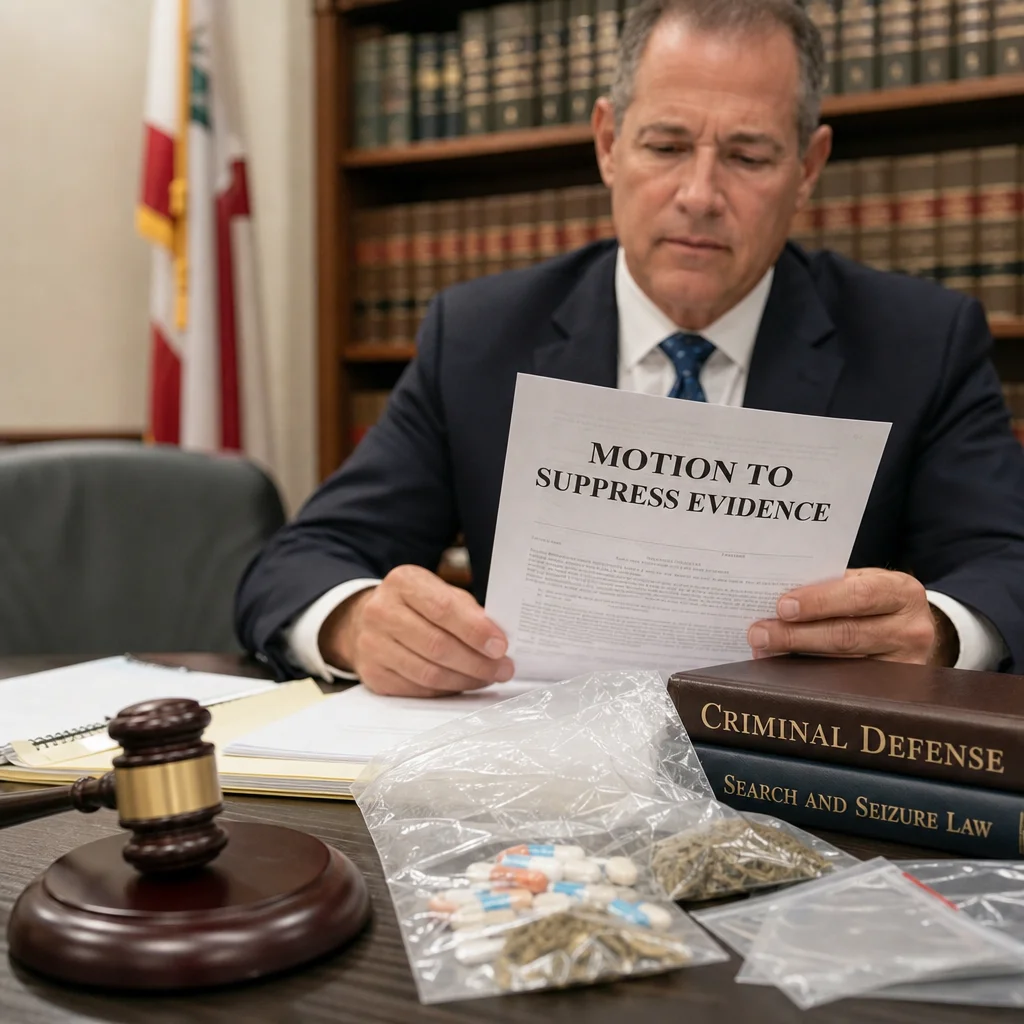
We have excluded drugs themselves, of course, but suppression extends to derivative evidence as well. If police find drugs during an unlawful search, any statements you made before, during, or after that search may also be suppressed as fruits of the poisonous tree.
Statements become particularly important when you face distribution charges. Prosecutors often rely on statements about quantity, intent to distribute, or customer lists to prove their case. If those statements resulted from an unlawful search or arrest, they become inadmissible.
We also challenge:
- Financial records and bank transfers obtained without warrant
- Cell phone location data and call records obtained without probable cause
- Communications retrieved through unlawful search warrants
- Evidence derived from illegal interviews conducted without proper warnings
Excluding derivative evidence sometimes eliminates the prosecution’s ability to prove their case entirely, even if the physical drugs themselves remain admissible.
Why Courts Grant Suppression Motions in Drug Possession Cases
California courts take Fourth Amendment violations seriously. When we present clear evidence that police violated constitutional protections, judges grant our motions to suppress because they must. Judicial discretion ends when a constitutional violation is established.
Courts recognize that police conduct must be predictable and lawful. If officers could ignore search requirements whenever they suspected drug possession, the Fourth Amendment would provide no real protection. Courts therefore strictly apply suppression doctrine.
We succeed most often when the violation is clear-cut: a search conducted without any warrant, consent, or legal exception. We also succeed when the scope of a lawful search is exceeded or when probable cause or reasonable suspicion never existed.
Even close cases can result in suppression when we present credible evidence contradicting the officer’s account. We have won suppression motions by impeaching officer testimony with body camera footage and dispatch records.
The Critical Difference Between Public Defenders and Dedicated Defense
Public defenders manage overwhelming caseloads and limited resources. A busy public defender might review your case file for a few hours before the suppression hearing, while we prepare for weeks or months.
We dedicate extensive time to understanding the precise facts of your case. We obtain every available recording, review it frame by frame, and prepare detailed outlines for cross-examination. We prepare declarations from experts where appropriate and file comprehensive written motions that educate the court about relevant law.
Public defenders often approach drug possession cases assuming suppression will not succeed and therefore focus on negotiating the best available plea. We start with the opposite assumption: the search violated your rights unless the government proves otherwise.
This difference in approach leads to measurably different outcomes. Clients represented by dedicated defense counsel secure dismissals that similarly situated clients represented by overworked public defenders never obtain.
Your Next Steps: Securing a Motion to Suppress Hearing
If you have been arrested for drug possession in San Diego County, Riverside County, San Bernardino County, or Orange County, your immediate priority is securing experienced representation who will evaluate suppression strategy from day one.
Contact our office for a free 24/7 consultation. We will review the circumstances of your arrest, examine police reports, and explain whether suppression strategy applies to your situation. We handle suppression motions on a flat-fee basis, so you understand the cost upfront without unexpected bills.
Bring any police reports, arrest reports, or documentation about your case to your consultation. If you have dashcam or body camera footage, those materials are particularly valuable. We will review everything and develop a candid assessment of whether suppression is viable in your case.
Time matters significantly. The sooner we engage, the sooner we can file our motion and preserve evidence that may otherwise deteriorate or disappear.
How We’ve Helped Southern California Defendants Get Charges Dismissed
Over our decades defending drug possession cases, we have helped numerous clients secure dismissals through successful suppression motions. Clients who faced prison time, probation, and permanent criminal records found their charges dismissed before trial because police violated their constitutional rights.
One client was stopped at a DUI checkpoint where the officer claimed to smell marijuana. The officer extended the stop beyond its lawful scope to conduct a vehicle search. We challenged both the initial basis for prolonging the stop and the scope of the vehicle search. The court suppressed the drugs, and the prosecution dismissed the case.
Another client faced distribution charges based on statements made during a prolonged, unlawful detention. We established that police lacked reasonable suspicion to extend the traffic stop, rendering all subsequent seizures and statements unlawful. The suppression motion excluded both the physical drugs and the statements, eliminating the prosecution’s ability to prove intent to distribute.
These outcomes did not result from technicalities or innocent people escaping punishment. They resulted from law enforcement violating constitutional procedures designed to protect everyone’s rights. Our role was to enforce those procedures through zealous advocacy.
If you face drug possession charges, suppression strategy may provide the path to dismissal. Contact our office today to discuss your case with experienced defense counsel who has successfully challenged unlawful searches for over three decades.
For further reading: Ways to suppress evidence.
Frequently Asked Questions (FAQ)
What happens if we can prove police violated your Fourth Amendment rights during a search?
If we demonstrate that law enforcement conducted an unlawful search or seizure, we file a motion to suppress that evidence. When the court grants our motion, the illegally obtained evidence becomes inadmissible in your case, which often results in charges being dismissed entirely or significantly weakened. We’ve successfully challenged searches involving improper traffic stops, warrantless vehicle searches, and searches without probable cause across San Diego, Riverside, San Bernardino, and Orange Counties.
How do we identify violations that make evidence inadmissible in drug possession cases?
We thoroughly review the circumstances of your arrest by examining police reports, dash cam footage, body camera recordings, and dispatch records to identify Fourth Amendment breaches. Common violations we challenge include searches without valid consent, searches exceeding the scope of a lawful stop, and searches conducted without probable cause or a warrant. Our strategic analysis focuses on the specific facts of your situation rather than generic legal arguments, which is why we secure suppression motions that public defenders often miss due to their heavy caseloads.
Why should we represent you instead of relying on a public defender for your motion to suppress?
We dedicate our resources exclusively to your case and build comprehensive suppression strategies from day one, whereas public defenders manage hundreds of cases simultaneously. Our flat-fee pricing and flexible payment plans make dedicated representation accessible, and we’re available 24/7 to discuss your legal options. We’ve helped numerous Southern California defendants get charges dismissed through successful motions to suppress that protect their records and freedom.


