
Top 7 DUI Plea Bargain Strategies in San Diego to Avoid Jail Time
29
Sep
Top 7 DUI Plea Bargain Strategies in San Diego to Avoid Jail Time
Table of Contents
- 1. Understanding Plea Bargain Basics and Your Rights
- 2. Evaluating Prosecutor Offers vs. Trial Risk Assessment
- 3. Challenging Breathalyzer and Blood Test Evidence
- 4. Negotiating Reduced Charges to Misdemeanor Status
- 5. Securing Alternative Sentencing: Probation, Community Service, and Education Programs
- 6. Leveraging First-Offense Status for Maximum Leniency
- 7. Why Our Strategic Approach Secures Better Outcomes Than Public Defenders
- Frequently Asked Questions (FAQ)
1. Understanding Plea Bargain Basics and Your Rights
Facing a DUI charge in San Diego puts your freedom, employment, and reputation at immediate risk. The pressure to resolve quickly is real, but accepting the first offer from a prosecutor often leads to unnecessary jail time and a permanent record. We’ve spent decades defending clients throughout San Diego County, Riverside County, San Bernardino County, and Orange County, and we’ve learned that strategic plea negotiation can mean the difference between incarceration and probation, between a felony conviction and a misdemeanor, between a ruined future and a second chance.
This guide walks you through seven proven DUI plea bargain strategies we use to secure outcomes that protect your freedom and livelihood. Each strategy targets specific weaknesses in the prosecution’s case or leverage points we can exploit to push for leniency.
A plea bargain is a negotiated agreement where you agree to plead guilty or no contest to certain charges in exchange for the prosecutor dropping or reducing other charges, or the judge imposing a lighter sentence. This isn’t a sign of guilt or weakness; it’s a calculated legal strategy that often produces better results than trial.
Your constitutional rights remain central to every negotiation. You have the right to:
- Demand full discovery of evidence against you
- Refuse any deal and proceed to trial
- Have counsel present during all negotiations
- Withdraw a guilty plea under specific circumstances if the judge later deviates from the agreed sentence
Many defendants assume plea bargains are one-time offers that expire quickly. That’s rarely true. Prosecutors negotiate throughout pretrial proceedings, and strategic delay often improves your position as they prepare for trial and realize weaknesses in their case emerge.
Your immediate action: Request a complete evidence file from the prosecutor, including police reports, breathalyzer calibration records, and dash cam footage. Don’t negotiate blindly.
2. Evaluating Prosecutor Offers vs. Trial Risk Assessment
The prosecutor’s opening offer is almost never their best one. We analyze each offer against the actual strength of their evidence, your personal exposure at trial, and the judge’s typical sentencing patterns in San Diego County courtrooms.
Here’s the calculation: If you go to trial and lose, what’s the maximum exposure? A first-time DUI conviction in California carries up to six months in jail, a $1,000 fine, and a suspended license. But if the prosecutor’s offer is probation with no jail time, a reduced fine, and mandatory education programs, you’ve already won the negotiation.
Conversely, if the offer includes jail time and you have strong evidentiary defenses (we’ll address this below), trial risk may be lower than accepting incarceration.
Key factors we weigh:
- Strength of the breathalyzer or blood test evidence
- Officer credibility and procedural compliance
- Your driving pattern and any actual impairment indicators
- Whether there was a lawful traffic stop (many aren’t)
- Your personal circumstances: employment, family, prior record
We’ve seen many cases where the prosecutor begins with 30 days jail time, but after we identify testing irregularities or stop-and-frisk violations, they move to probation only. The difference is pressure and informed advocacy.
Your immediate action: Never make a counteroffer without understanding what jail time actually looks like if you lose at trial. That’s your baseline comparison point.
3. Challenging Breathalyzer and Blood Test Evidence
The reliability of chemical testing is often the prosecution’s strongest card and your best negotiating lever. DUI cases hinge on proving your blood alcohol concentration (BAC) exceeded the legal limit, but the machines and procedures aren’t bulletproof.
Common breathalyzer vulnerabilities we exploit include:
- Improper calibration or maintenance records (many departments miss required recalibration windows)
- Operator error or inadequate training certification
- Environmental factors affecting the reading (radio frequency interference, acetone from medical conditions)
- Mouth alcohol contamination within 15 minutes before testing
Blood tests have their own weaknesses:
- Chain of custody breaks that allow cross-contamination
- Lab tech mistakes in sample processing or storage
- Improper blood draw technique affecting sample integrity
- Fermentation of the blood sample if preservatives were inadequate
When we request and review calibration logs, maintenance schedules, and operator certifications, we frequently find documentation failures that undermine the test’s reliability. Even if the test is technically valid, these gaps give us negotiating ammunition. The prosecutor knows that if we take the case to trial and expose these issues to a jury, reasonable doubt enters the picture.
We’ve negotiated felony DUI charges down to misdemeanor and jail time down to probation purely by making it clear we’ll challenge the chemical evidence thoroughly in open court.
Your immediate action: Request all calibration records, maintenance logs, and the operator’s certification for the specific breathalyzer or blood draw used in your case. These documents reveal the prosecution’s weak spots immediately.
4. Negotiating Reduced Charges to Misdemeanor Status
A felony DUI conviction (often triggered by prior DUI convictions within ten years or injury to another person) carries consequences that derail careers and housing applications for years. A misdemeanor DUI, while still serious, is far more manageable and increasingly gets expunged after probation completion.
The prosecutor doesn’t want to drop the felony charge entirely; that looks like a loss. But they do care about trial workload, jury unpredictability, and evidentiary strength. If we can show that the injury allegation lacks causation, or that prior DUIs were decades old and shouldn’t carry the same weight, we create room to negotiate down to misdemeanor.
We often frame this as a win for the prosecution: “My client accepts responsibility, will comply with probation, and you avoid the jury trial and appellate risk of a felony.” That language, combined with evidence weaknesses, opens negotiating doors.
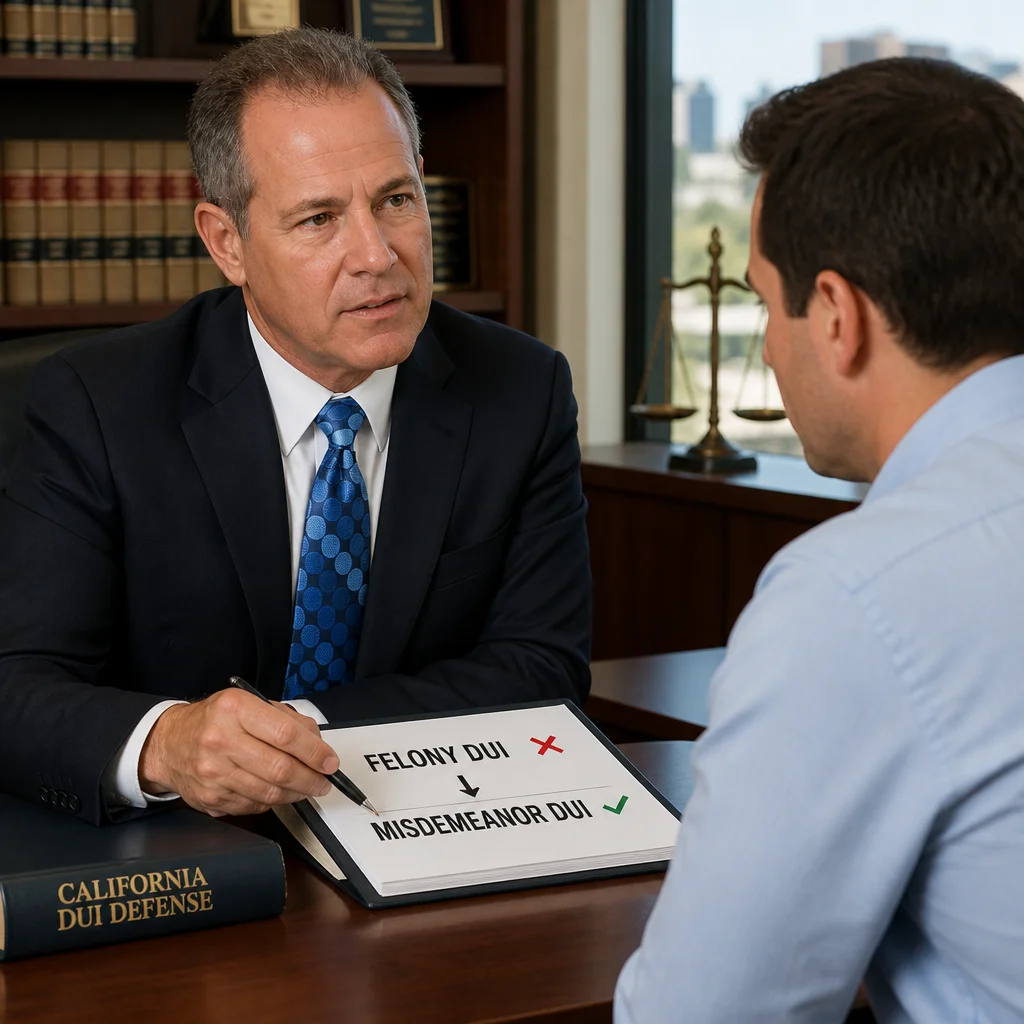
For clients facing Felony to Misdemeanor Reduction, this is a critical phase. We evaluate whether the prior convictions truly qualify under enhancement statutes, whether the injury allegation holds up under scrutiny, and whether the prosecutor’s timeline and case preparation suggest they’re ready for a long fight.
Your immediate action: If you’re facing a felony DUI, identify exactly what triggered the felony designation. Was it a prior conviction, injury allegation, or property damage? Attack that foundation first.
5. Securing Alternative Sentencing: Probation, Community Service, and Education Programs
Jail time is one sentencing lever. But California offers alternatives that satisfy public safety concerns while preserving your freedom and employment. We push hard for these in every plea negotiation.
Standard alternatives include:
- Formal or informal probation (often three to five years)
- DUI education programs (first-offender programs, 12-hour or 30-hour courses depending on BAC level)
- MADD victim impact panels
- Community service hours (often 40 to 96 hours)
- Restricted driver’s license with ignition interlock device requirements
- Restitution to any accident victims
The prosecutor and judge are often willing to stack these requirements instead of imposing jail time. From their perspective, community service, mandatory education, and probation supervision achieve the same deterrence goals without the public cost of incarceration.
We’ve seen judges assign 96 hours of community service plus a mandatory 30-hour DUI program plus probation, with zero jail time, because the client had stable employment and family ties. That outcome isn’t luck; it’s negotiation strategy combined with presenting the client as low-risk and compliant.
Your immediate action: Research which DUI education providers operate in your county. Being enrolled or nearly enrolled before sentencing demonstrates commitment and gives the prosecutor a reason to offer probation instead of jail.
6. Leveraging First-Offense Status for Maximum Leniency
First-time DUI offenders receive dramatically lighter treatment than repeat offenders. Prosecutors and judges view first offenses differently because rehabilitation potential is highest and public safety risk is lower.
California courts distinguish between:
- First-offense DUI: Misdemeanor charge, probation-eligible, record can be expunged after probation
- Second offense within ten years: Mandatory minimum jail time (typically 96 hours to six months)
- Third or subsequent offense: Felony territory with one-year minimum sentences
If you’re a first offender, we emphasize this relentlessly in negotiations. We highlight stable employment, community ties, family responsibilities, and your commitment to never driving under the influence again. We present character references and sometimes arrange for early entry into DUI education programs to show immediate accountability.
The negotiating shift is substantial. Where the prosecutor might offer 30 days jail for a second-offender scenario, a first-time offender may get probation-only or weekend jail (which preserves employment). That difference is everything.
Additionally, first-offense status unlocks expungement opportunities. Under California Penal Code Section 1203.4, you can petition to have the conviction dismissed from your record after successfully completing probation. That’s a permanent solution to the collateral damage of a DUI conviction.
Your immediate action: Document your employment history, community involvement, and any charitable work. If this is your first offense, compile character references from employers, community members, or religious leaders. This evidence directly influences prosecutor and judicial discretion.
7. Why Our Strategic Approach Secures Better Outcomes Than Public Defenders
Public defenders handle enormous caseloads in San Diego County courts. With 300 to 400 cases per attorney annually, they often negotiate quickly to clear their docket rather than invest time in deep case investigation and leverage building. The reality is that a public defender may have limited time to review calibration records, file motions challenging the traffic stop, or develop alternative sentencing proposals.
We operate differently. We investigate every case thoroughly. We request calibration records, operator certifications, and dash cam footage before negotiating. We file motions that expose evidentiary weaknesses and force the prosecution to commit to their evidence. We develop comprehensive sentencing proposals that demonstrate lower risk and higher likelihood of compliance. We negotiate strategically, not expeditiously.
Over 30 years of courtroom experience across San Diego County, Riverside County, San Bernardino County, and Orange County, we’ve built relationships with prosecutors and judges who understand our reputation for thorough preparation. When we tell a prosecutor we’re ready to challenge their breathalyzer evidence, they know we’ve done the work. When we propose an alternative sentencing package, it’s comprehensive and thoughtful.
Our flat-fee pricing structure means you’re not paying by the hour for quick settlements. You’re paying for a complete, strategic defense. We have the flexibility to invest the time that public defenders simply cannot, and we offer 24/7 free consultations so you can speak with us immediately after your arrest.
The difference in outcomes is measurable: clients working with us secure probation-only resolutions, misdemeanor reductions, and jail avoidance at rates that significantly exceed public defender outcomes for comparable cases.
If you’re facing a DUI charge in San Diego, Riverside, San Bernardino, or Orange County, contact us for a free consultation. We’ll review your evidence, evaluate the prosecutor’s position, and outline exactly which strategies apply to your case. We’ll show you how aggressive investigation and strategic negotiation create outcomes that protect your freedom and future.
Frequently Asked Questions (FAQ)
What plea bargain options do we typically pursue for DUI cases in San Diego?
We focus on negotiating reduced charges, alternative sentencing arrangements, and probation-based solutions tailored to your specific circumstances. Our strategy depends on factors like your BAC level, prior record, and the strength of the prosecution’s evidence, which we evaluate thoroughly during our free consultation. We’ve found that challenging breathalyzer accuracy or procedural errors often gives us leverage to secure significantly better outcomes than accepting the initial offer.
How do we determine whether you should accept a plea deal or go to trial?
We conduct a detailed risk assessment comparing the prosecutor’s offer against your trial prospects, considering the quality of evidence against you and potential sentencing ranges. If the evidence is weak or improperly obtained, trial may be your better option. Our 24/7 availability means we can discuss your specific situation immediately and provide honest guidance about whether accepting a plea protects your future better than proceeding to court.
Can we help reduce a felony DUI charge to a misdemeanor?
Yes, we regularly negotiate felony DUI reductions to misdemeanor status, which can mean avoiding mandatory jail time and protecting your employment and housing prospects. This depends on factors like prior convictions, accident involvement, and injury circumstances. We’ll identify every viable angle to present to the prosecutor, from challenging evidence to highlighting your ties to the community and rehabilitation potential.